

We’ve seen a few questions around how your allocation is calculated, why everyone can commit at least $5,000, and what happens if the sale is oversubscribed.
The system is designed around two goals:
Give every eligible user a meaningful opportunity to participate.
Reward users who have contributed more to Multipli through ORBs, Crystals and other eligible reward programs.
The easiest way to understand it is to separate your Earned Allocation from your Eligible Allocation.
1. What is my Earned Allocation?
Your Earned Allocation is the amount you have earned based on your ORBs, Crystals and other applicable rewards.
A portion of $MULT has been specifically set aside for these holders:
1% of $MULT is allocated towards ORB holders
0.178% of $MULT is allocated towards Crystal holders
The value of each ORB and Crystal is calculated based on the size of its respective allocation pool and the total number eligible.
In simple terms:
Value per ORB = USDC value of the ORB allocation pool ÷ total eligible ORBs
Value per Crystal = USDC value of the Crystal allocation pool ÷ total eligible Crystals
Your Earned Allocation is then:
Earned Allocation = (ORBs held × value per ORB) + (Crystals held × value per Crystal)
Other eligible reward programs follow a similar methodology and are added where applicable.
Example
Let's say your ORBs and Crystals give you an Earned Allocation of:
$600
That $600 represents the allocation you directly earned through your ORBs and Crystals.
But you won't be limited to participating with only $600.
2. Why can I still commit $5,000?
We want every eligible community member to have a meaningful chance to participate.
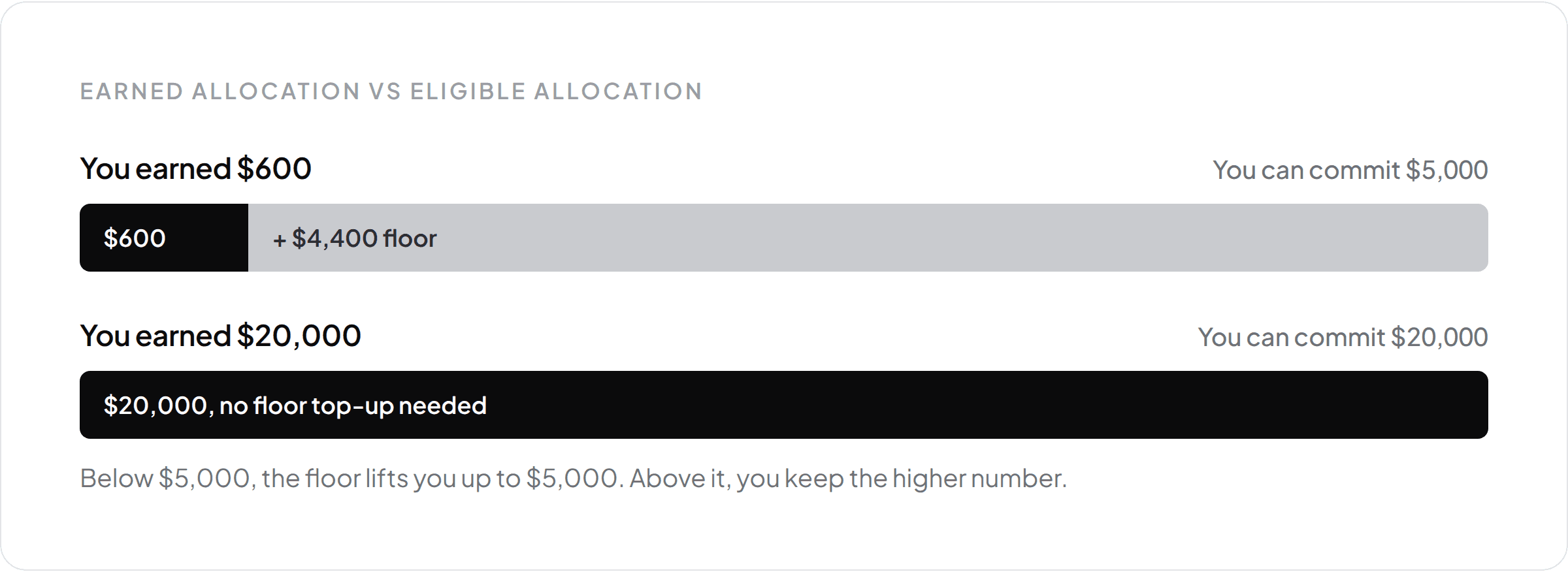
Because of this, if your Earned Allocation is below $5,000, we increase your Eligible Allocation to $5,000.
So in the example above:
Earned Allocation: $600
Eligible Allocation: $5,000
Maximum you can commit: $5,000
This means that even though your ORBs and Crystals earned you $600 of allocation, you are still given the opportunity to commit up to $5,000 at the $100M FDV, compared to the $250M pre-sale valuation.
If your Earned Allocation is already above $5,000, then you get the higher allocation.
For example:
Earned Allocation: $20,000
Eligible Allocation: $20,000
Maximum you can commit: $20,000
So the rule is very simple:
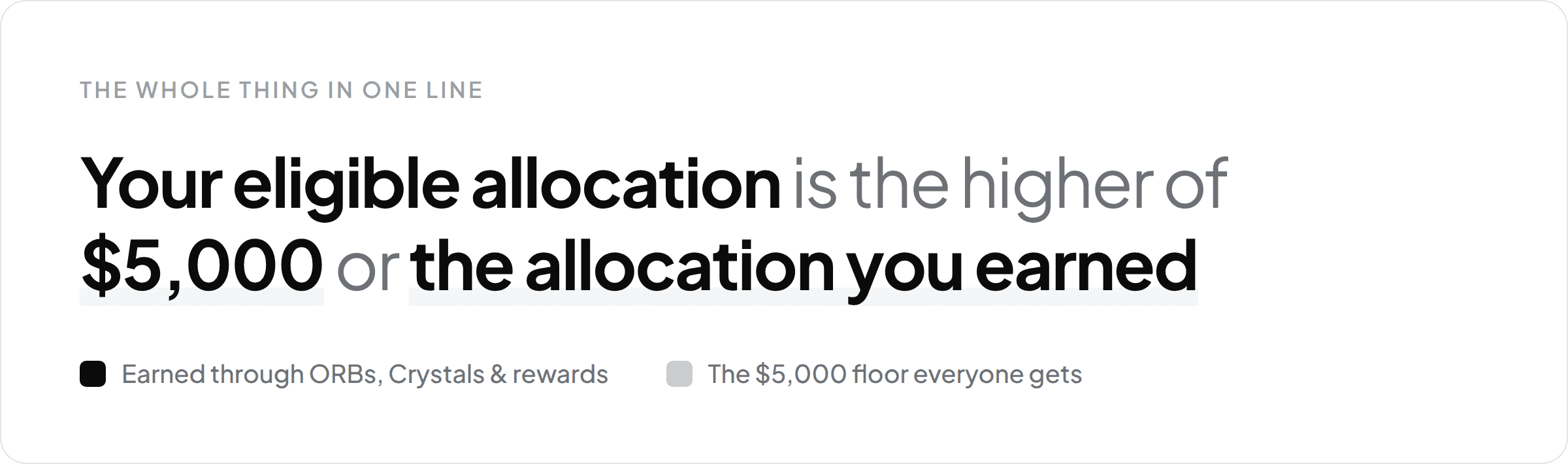
Your Eligible Allocation is the higher of $5,000 or the allocation you earned through ORBs, Crystals and applicable rewards.
3. What happens if the sale is not oversubscribed?
Nothing complicated.
If your Eligible Allocation is $5,000 and you commit $5,000, you can receive the full $5,000.
If your Eligible Allocation is $20,000 and you commit $20,000, you can receive the full $20,000.
The additional rules only become relevant if total commitments exceed the amount available in the sale.
4. What happens if the sale is oversubscribed?
Let's use a simple example.
Assume there is $100,000 of allocation available.
Users collectively commit:
$105,000
The sale is now $5,000 oversubscribed, so we cannot simply fill every commitment in full.
This is where the distinction between Earned Allocation and the $5,000 minimum Eligible Allocation becomes important.
We first go back to the allocation each user actually earned through their ORBs, Crystals and applicable rewards, before any user was bumped up to the $5,000 minimum.
For example:
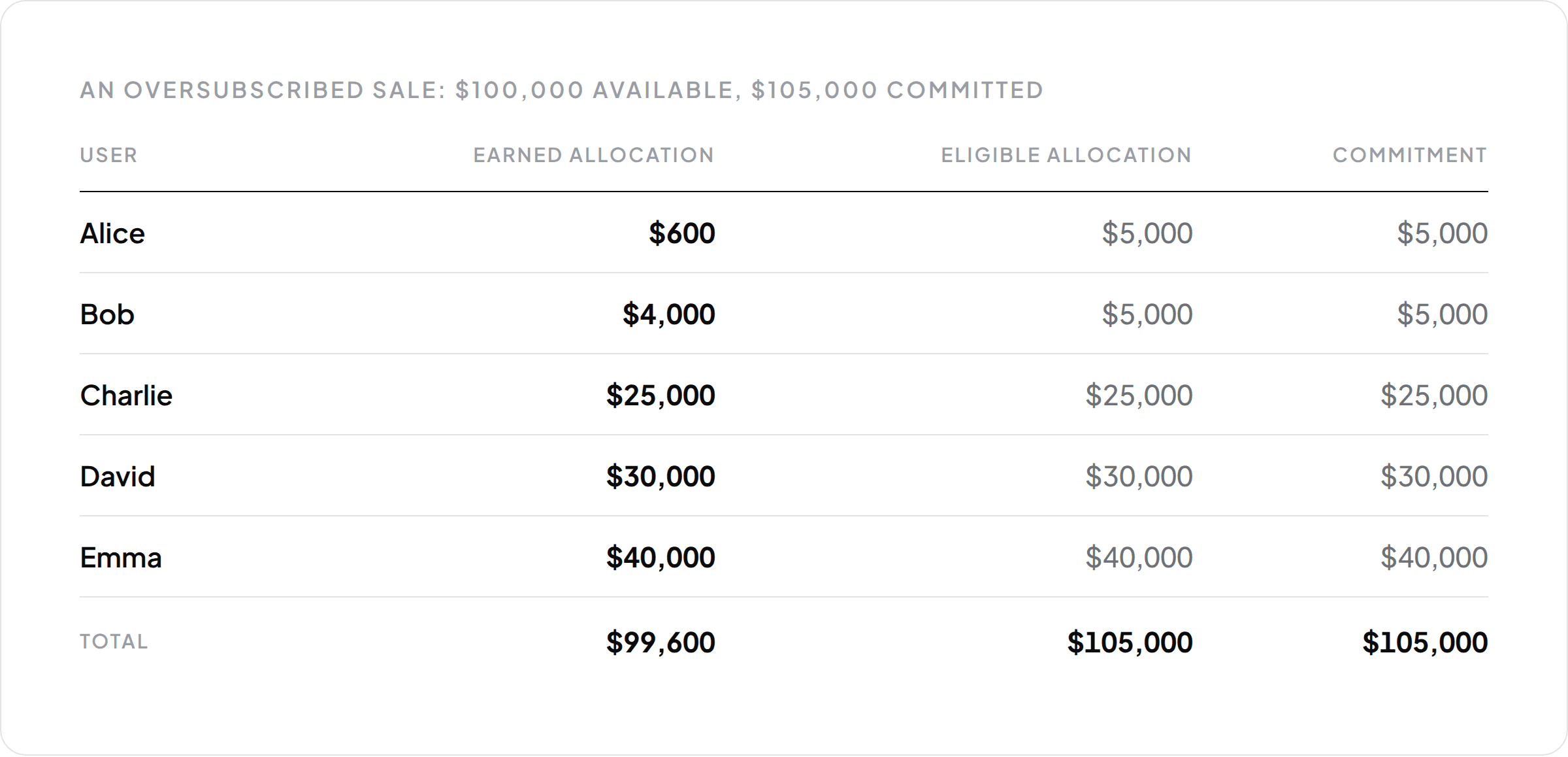
There are $105,000 of commitments but only $100,000 available.
However, the users in this example originally earned $99,600 of allocation through ORBs and Crystals.
That $99,600 is considered first.
This leaves $400 of allocation remaining.
The remaining demand came from the additional $5,000 minimum allocation we gave to users such as Alice and Bob.
That remaining allocation can then be distributed based on the same contribution priority, meaning users with greater underlying ORB and Crystal participation receive priority.
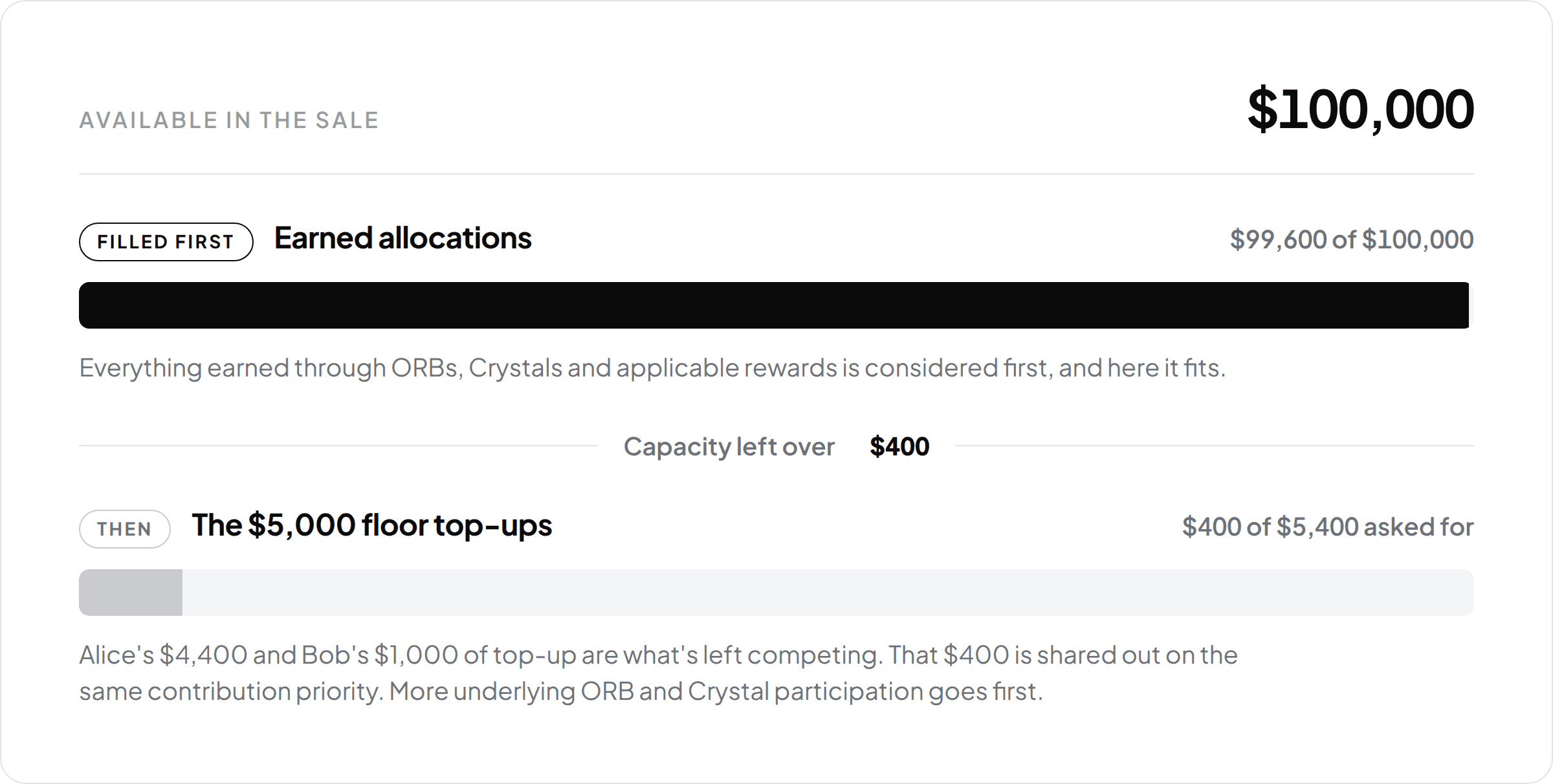
This is why the $5,000 minimum gives everyone an opportunity to participate, but does not give everyone the same priority in an oversubscribed sale.
5. What if the Earned Allocations themselves are already oversubscribed?
There is one more possible scenario.
Suppose the sale has $100,000 available, but the combined Earned Allocations of everyone participating already total $120,000, even before applying the $5,000 minimum.
In that case, there is no additional $5,000 bump to consider.
The $100,000 available is simply distributed pro-rata across the Earned Allocations.
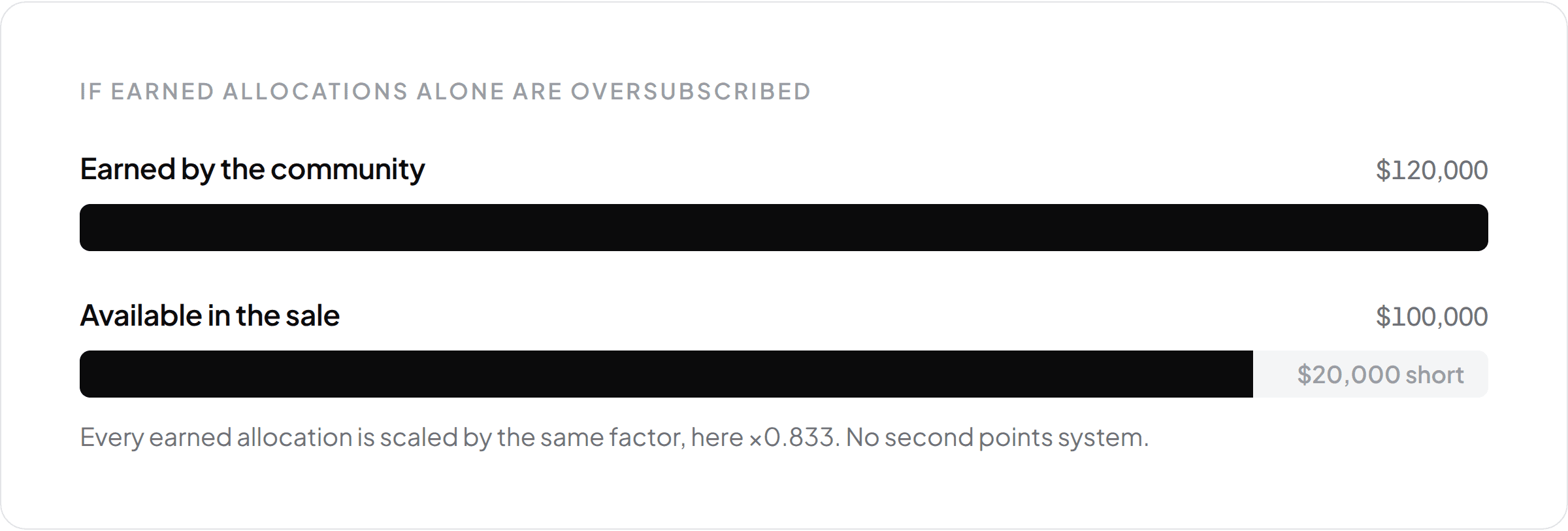
So if the community has collectively earned more allocation through ORBs and Crystals than the sale can accommodate, everyone is scaled down proportionally based on what they earned.
This means we do not need another complicated points system or a completely separate allocation formula.
Your ORBs and Crystals have already determined the relevant weighting.
The easiest way to think about it
There are really only three steps:
1. We calculate what you earned
ORBs + Crystals + applicable rewards
↓
Your Earned Allocation
2. We make sure everyone gets a meaningful chance to participate
If your Earned Allocation is below $5,000
↓
Your Eligible Allocation is increased to $5,000
This is the maximum you can commit at the $100M FDV.
3. If the sale is oversubscribed
We go back to the Earned Allocation before the $5,000 bump.
↓
Those allocations are considered first.
↓
If the Earned Allocations themselves exceed the available sale allocation, they are scaled pro-rata.
This allows us to give every eligible user a meaningful opportunity to participate while still making sure that the users who accumulated more ORBs, Crystals and rewards receive the benefit they earned.

